
Tire Maintenance for Beginners
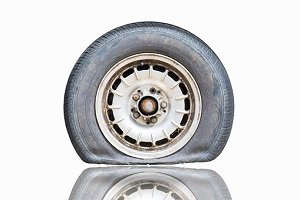
No Spare Tire?
So You Get A Flat Tire...What Now?
Nobody ever looks forward to a flat tire, and nobody ever says "well, that was a really good time" after having one. You can at least minimize the damage to your tire and danger to yourself, though.
Flats vs Blowouts
If you get a blowout, you'll know about it right away. Sometimes the tire can fail dramatically, with a bang as loud as a shotgun going off. Other times, it might just be a loss of air and a sudden change in your car's handling, followed by vibration, noise and a pull to one side. If it's a front tire that fails, your car might be a real handful to drive until you can get to a stop.
In either case, your first job is to pull off the road as quickly (but safely!) as you can. Don't jam on the brakes or make any sudden moves, just get over to the shoulder and the flattest, hardest surface you can find.
Turn on the emergency flashers and set the parking brake. Locate the jack and tire wrench, remove t ...[more]
4 Things About Tires You May Not Have Known
Tires all look sort of the same…round and black…and people tend to think tires don’t change much over the years. That’s really not true, though – engineers and designers are constantly working on advances in tire designs for more miles, better fuel economy and better performance.
Here’s a rundown of current trends in tire technology you may not have been aware of:
- Tall, skinny tires are coming back. If you’ve ever ridden a beach cruiser bike vs. a racing bike, you know that skinny tires have lower rolling resistance. Carmakers are going in that direction, too – the BMW i3 electric/plug-in hybrid uses Bridgestone Ecopia tires, with higher inflation pressure and a taller, skinnier profile. Tall, skinny tires also reduce the car’s frontal profile for lowered wind resistance and aerodynamic drag. It isn’t just the BMW i3, either&helli ...[more]
What Makes All-Season Tires So Great?
So your closet has a pair of flip-flops for the summer, a pair of heavy boots for the winter, and a comfortable pair of sneakers for most of the rest of the year. If you live in a climate that doesn’t have harsh winters, you might just be able to wear those sneakers year-round...and all-season tires are the equivalent of your comfortable sneakers.

So what makes all-season tires so special?
Winter tires are excellent for severe conditions like heavy snow and even ice. They feature specially-designed tread patterns and “sipes”, hundreds of tiny slits which offer biting edges for traction in snow. This means shorter stopping distances, better handling and better control ...[more]
Archives
Tags
